Next Exams
Exam and assessment management for Joomla — a nine-type question bank, a server-authoritative exam runner, automatic grading, certificates and live invigilation, all inside your own site.
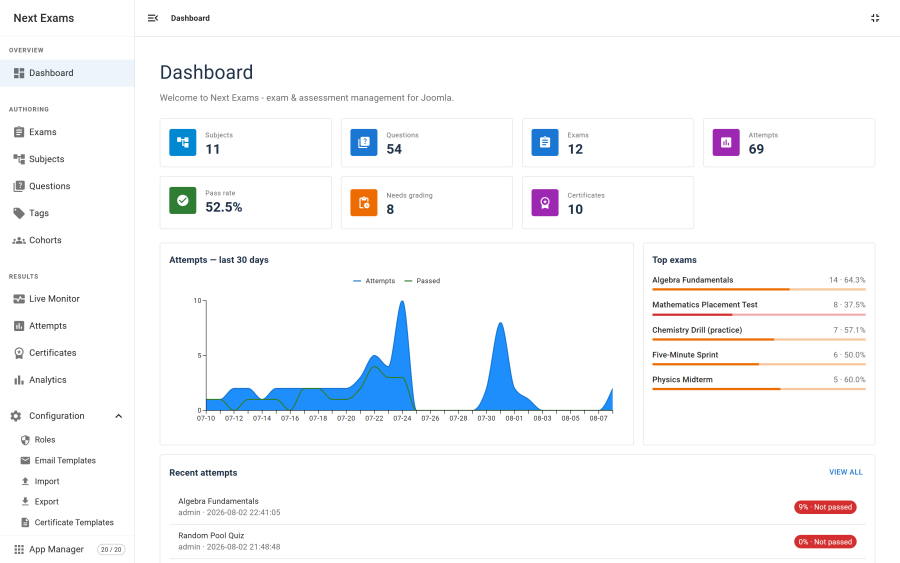
What It Does
Joomla has no native way to assess anyone. Sites that need one usually reach for a form extension pressed into service as a quiz, or send learners out to an external testing platform that then owns the questions, the results and the personal data. The first gives you no question bank worth maintaining and no grading beyond a score; the second takes your assessment off your own site entirely.
Next Exams brings the whole assessment lifecycle into Joomla. Authors build a reusable question bank filed against a subject tree, then assemble exams from fixed questions, randomised pools, or a mix of both. Examinees sit the exam in a runner where the clock, the question set and the score all live on the server, so a tampered browser changes nothing — and because the runner is a real HTML form enhanced with JavaScript rather than replaced by it, it still submits with scripting switched off.
After the submit, eight of the nine question types grade themselves with partial credit; essays queue for a human marker. Results can be released immediately, on a schedule, or by hand, broken down per subject so a learner knows what to revise. Passing can issue a PDF certificate with a public QR verification page. Meanwhile you can watch the room live, see which questions are doing no discriminating work, and push every result out over LTI 1.3, signed webhooks or a token-authenticated JSON API.
Key Concepts
| Term | Meaning |
|---|---|
| Subject | A node in a hierarchical tree that questions and exams are filed under. Paths are maintained automatically, so moving a branch re-files everything beneath it. |
| Question | One item in the bank, of one of nine types. Choice options are stored as rows with stable identifiers; non-tabular grading rules live in a small answer key alongside. |
| Exam | A published assessment. Combines fixed questions and pool rules with a time limit, an access rule, a taking mode and a result-release policy. |
| Pool rule | An instruction to draw a number of questions at random from a subject or tag. The draw happens once, when an examinee starts. |
| Attempt | One person's run at one exam. Holds the frozen question set, the answers, the timing state and the score. |
| Question set | The exact paper an examinee received, frozen at start — including the taking mode. Editing the exam afterwards never changes a running attempt. |
| Access gate | The rule deciding who may start: view level (which is how an exam is made public), open registration, shared code, identified guest, or a named allow-list. |
| Cohort | A named roster — hand-picked users, a mirrored Joomla user group, or email invitations for people with no account yet. |
| Role | A Next Exams permission set granting actions per feature, assigned to Joomla users or groups. Separate from Joomla's own ACL. |
| App | One of twenty-six switchable capabilities. Turning one off hides its interface and blocks its endpoints without deleting any data. |
Key Features
- Nine question types — multiple choice single and multiple, true/false, short answer, essay, ordering, matching, extended matching and cloze. See Question Bank.
- Fixed questions and random pools — pin what must appear, draw the rest at random per examinee. See Exam Builder.
- Server-authoritative runner — delta autosave, pause and resume, practice mode, and a no-JavaScript fallback that still submits. See Exam Runner.
- Automatic grading with partial credit — plus manual marking for essays and locked review while marking is pending. See Grading & Results.
- Certificates with QR verification — a visual designer, issue-on-pass, expiry, and a public verification page. See Certificates.
- Live invigilation — a real-time board, interventions, an audit log, and accountless invigilator invites by link or PIN. See Live Monitoring.
- Item analysis — difficulty and item-total discrimination per question, per-student reports, CSV export and scheduled emails. See Analytics & Reports.
- Cohorts and access rules — restrict an exam to an allow-list, with opening windows, attempt caps and cooldowns. See Cohorts & Enrollment.
- LTI 1.3, webhooks and API tokens — launch from an LMS with score passback, signed outbound notifications, and a default-deny bearer-token API. See LTI 1.3.
- App Manager — switch any of twenty-six capabilities off without deleting data, and back on again unchanged. See App Manager.
- WCAG 2.1 AA accessible — the whole exam-taking flow was remediated for keyboard, screen reader and reduced motion. See Accessibility.
- Fully translatable — English (en-GB) included; add any language with standard
.inifiles.
Requirements
| Requirement | Detail |
|---|---|
| Joomla | 4.4, 5.x or 6.x |
| PHP | 8.1 or later — the bundled libraries set this floor |
| MySQL / MariaDB | Required |
| PostgreSQL | Not supported — Next Exams ships a MySQL schema only |
| PHP extension — certificates | mbstring, dom and iconv, required by the bundled PDF renderer |
| PHP extension — certificate QR codes | gd recommended; without it the QR falls back to SVG |
| PHP extension — LTI 1.3 | openssl, for the tool's RSA key pair and signed tokens |
| PHP extension — QTI and Moodle XML import | simplexml |
| HTTPS | Strongly recommended — examinee answers and access codes transit every request |
Support
- Website: nextsoftware.dev
- Email: [email protected]
- Licence: GNU General Public License v2 or later